
What to Consider Before Building a Retaining Wall
Understanding what to consider before building a retaining wall starts with the problem the wall needs to solve. Do you need to hold back a slope, create level space for seating, form a raised planter, or manage an elevation change? Those goals shape the wall type, location, and work needed behind the finished surface.
This guide walks through the questions we consider with homeowners before a retaining wall project. It can help you describe your yard and understand why two walls that look similar may need different construction approaches. For an overview of the service itself, visit our retaining wall services page.
Call for a Quote
(951) 722-8150
Services
Call for a Quote
(951) 722-8150
Services
1• Start with the space you want afterward
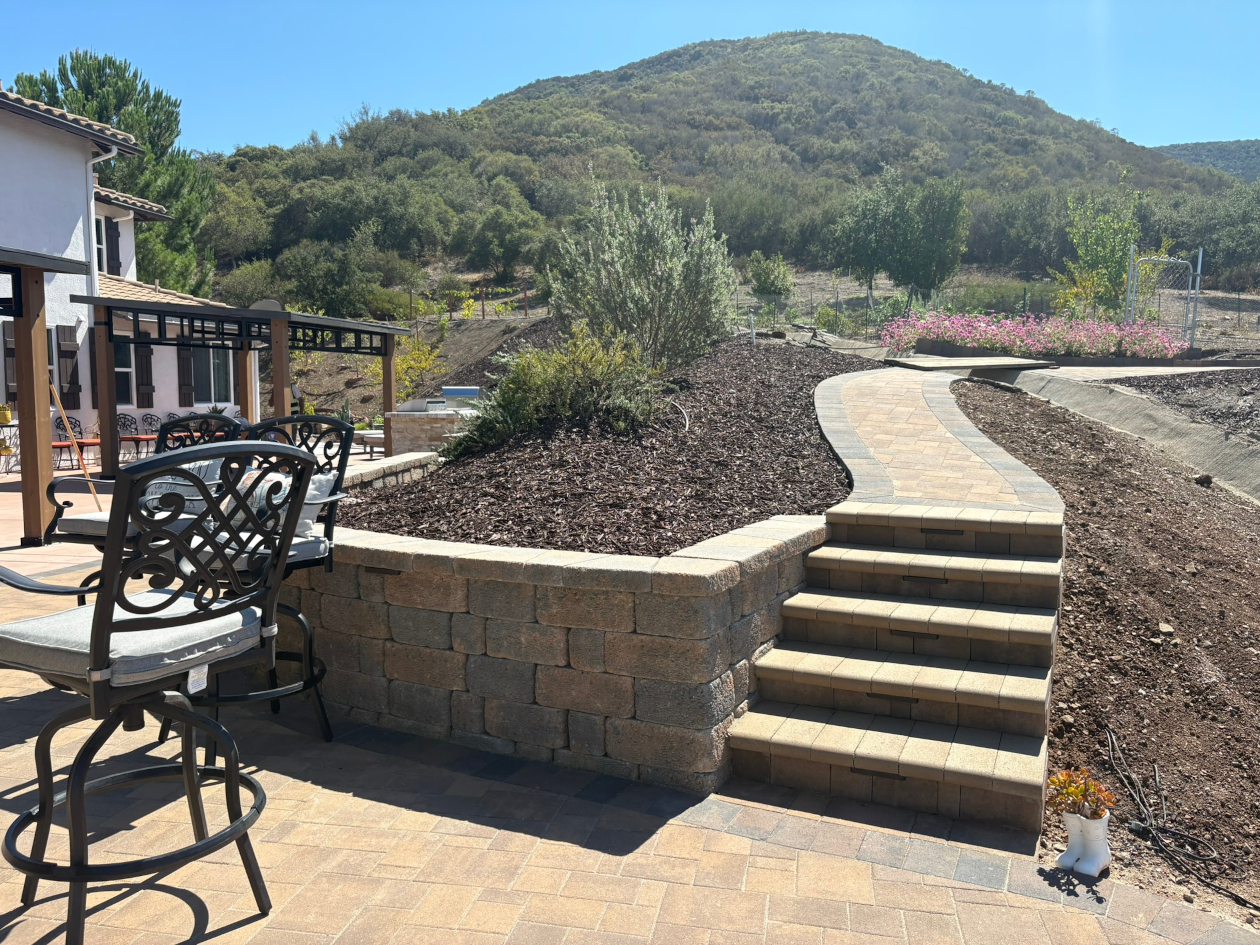
Picture how you will use the yard once the wall is finished. A wall that creates room to sit and entertain has a different purpose from a short garden wall around planting. Think about the area above and below it, where steps or a patio might go, and whether the yard must remain accessible for other work. On a Murrieta property we worked on, the homeowner wanted more space for sitting with family; the wall helped make that outdoor area usable. At the Preston project, a Country Manor retaining wall sits alongside a paver patio and sloped planting area, with steps connecting the patio to a curved paver walkway.
2• Look at the property before choosing a material
At an initial visit, we look at how much soil must be removed and whether the crew and equipment can reach the work area. Slope and nearby buildings, driveways, or parking areas may call for closer evaluation. In De Luz, we have worked around rocky hills. In Temecula Wine Country, we have encountered rock and clay. Conditions vary from one property to the next.
Tell the contractor about drainage problems you have noticed, changes to the slope, and where water flows during irrigation or rain. We have seen moisture from an overwatered neighboring property affect an existing wall. If ground remains excessively wet and the cause is unclear, we avoid working in the affected area until the issue is assessed and resolved. What is happening beyond the proposed wall can matter as much as the wall’s appearance.
3• Compare wall systems for the job
Country Manor and other segmental block systems can be used where a wall will hold soil and create usable space. Stonegate offers a more decorative stacked appearance. We often like CMU block with a stucco finish for a smoother look, particularly when a project calls for that construction method. Keystone may be considered when a homeowner is working within a tighter material budget. A garden wall may be suited to a raised planting area.
Ask why a particular system is recommended for your slope, the intended wall height, and the space around it. We have seen tree roots damage stacked walls, so nearby planting also belongs in the conversation. The choice should reflect the property and the completed landscape.
4• Understand what the finished wall hides
The work underneath and behind a wall affects how it performs. We consider excavation, base preparation and compaction, footing or base design, backfill, and reinforcement where needed. The materials and construction details depend on the wall system and the property conditions.
We have seen walls shift or collapse when preparation is poor, and walls can have trouble when ordinary soil or construction debris is used where suitable drainage material belongs. Ask your contractor what will be below the visible wall, what will be behind it, and how those details suit your property. The exact base and compaction method should be described for the proposed wall system.
5• Make a plan for water
We see poor drainage as a recurring cause of retaining wall trouble. Water can collect behind a wall and add pressure. We use crushed stone around perforated drain pipe to help keep soil out of the pipe. Each wall has a drainage outlet, either newly created or an existing outlet we use. We also consider surface runoff. Black protective coating is used on CMU and concrete walls only. The drainage layout and discharge location should be explained for the specific project.
If you already have a wall that is leaning, bulging, cracking, or holding moisture, those observations are worth mentioning during a site visit. They may help reveal how water and soil have behaved on the property. Ask where the new wall’s drainage will go, including what happens after irrigation or a heavy rain.
6• Discuss loads, approvals, and project scope early
A wall near a driveway, building, parking area, steep slope, or property line may need more evaluation than a small garden wall. We build walls in a range of sizes, and wall height can affect design and approvals. Projects requiring engineering or permits need additional planning time. Customers often ask us about permits and HOA approval. Requirements depend on the property and local authority, so the proposed wall needs to be evaluated on its own terms.
Rocky soil, limited equipment access, and tight working areas are recurring reasons one retaining wall job can take longer and cost more than another. The material you choose is only part of the project scope. Excavation, drainage, and any engineering or approval process also affect the work. A site visit gives the contractor a better basis for discussing cost and sequence than an estimate based only on wall length.
7• Questions at site visit
- What will the wall hold back, and how will we use the space it creates?
- Which wall system suits this property, and why?
- How will the base, backfill, and drainage be handled for this design?
- Where will water from behind and above the wall go?
- Do nearby structures, loads, property lines, or HOA rules call for additional review?
- What parts of the site or design could change the project scope?
Planning your retaining wall
Knowing what to consider before building a retaining wall gives you a clearer starting point for your project. Precision Outdoorscapes can look at your property, discuss the result you want, and explain the wall options that may fit. Visit our retaining wall services page for the service overview, or contact us to talk through your yard.